Your vehicle is engineered with bumpers, airbags, and a steel frame—all designed to protect you from harm. But how well they work often depends on the type of impact. A collision from behind sends a different shockwave through your car and body than an impact to the side. The direction and force of a crash tell a story, one of physics and consequences.
Gaining a basic understanding of the most common types of motor vehicle accidents can help you comprehend the forces you experienced, the potential injuries they can cause, and how seeking compensation through a motor vehicle accident claim can provide the resources you need to move forward.
Schedule a Free Case Evaluation
Key Takeaways about the Most Common Types of Motor Vehicle Accidents
- Rear-end collisions are extremely common, often resulting from distracted driving or following too closely.
- Side-impact, or "T-bone," accidents frequently happen at intersections and can cause severe injuries due to the limited protection on a vehicle's side.
- Head-on collisions, while less frequent, are the most dangerous and often result from impaired or wrong-way driving.
- Accidents in New York City often involve unique factors like "suicide gap" turns, aggressive lane changes, and a high volume of taxis and rideshare vehicles.
- The type of accident can provide important clues about liability, which is the legal term for determining who is at fault.
- Even in a single-vehicle crash, another party, such as a negligent driver who fled the scene or a government entity responsible for road maintenance, could be held accountable.
Rear-End Collisions: More Than Just a Fender Bender
Rear-end collisions are arguably the most frequent type of crash on our roads. From the stop-and-go traffic on the Brooklyn-Queens Expressway to a sudden stop on a quiet street in the Bronx, these accidents can happen anywhere. They occur when the front of one vehicle strikes the back of another. While some might dismiss them as minor "fender benders," the truth is that a rear-end impact can jolt the body violently, leading to serious injuries.
The most common injury associated with these crashes is whiplash, a soft-tissue injury to the neck caused by the head snapping forward and backward. However, more severe injuries like spinal cord damage, traumatic brain injuries (TBIs), and herniated discs are also possible, especially if the crash occurs at a high speed.
Common causes of rear-end collisions include:
- Distracted Driving: Texting, talking on the phone, or adjusting the GPS can take a driver's attention off the road for a critical few seconds.
- Tailgating: Following the vehicle ahead too closely leaves insufficient room to stop safely if the lead driver suddenly brakes.
- Speeding: A driver going too fast for the conditions may not be able to react in time to avoid a collision.
In many cases, the driver of the rear vehicle is considered at fault, but this is not always true. For example, if the lead car had non-working brake lights or suddenly reversed, liability could be more complex.
T-Bone or Side-Impact Collisions
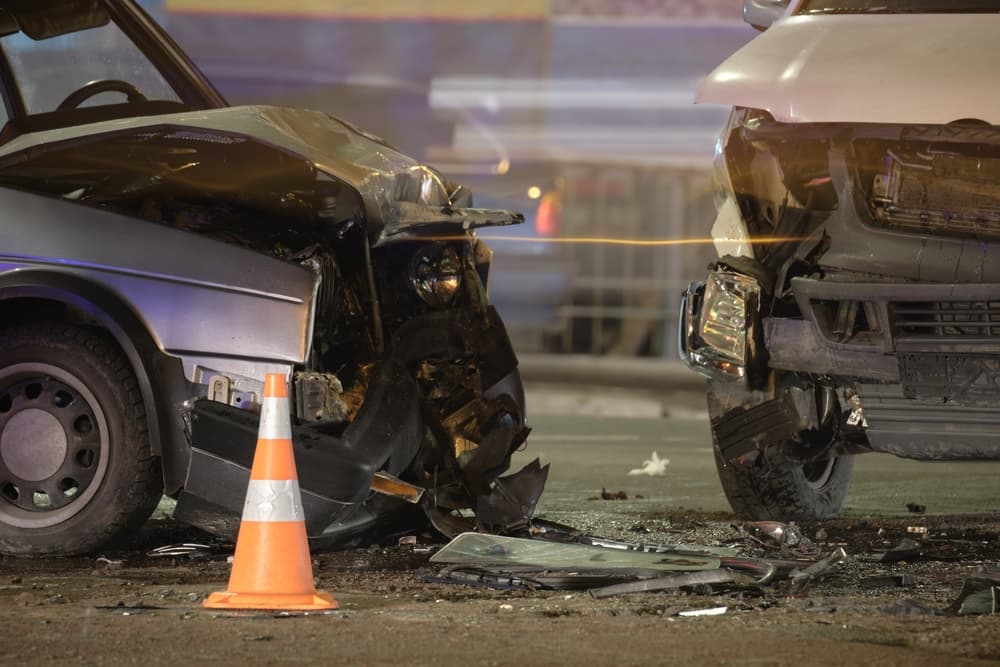
A T-bone, or side-impact, collision happens when the front of one car crashes into the side of another, forming a "T" shape. These are particularly dangerous because the sides of a vehicle offer far less protection than the front or rear, which have bumpers and large crumple zones designed to absorb impact. Even with side-impact airbags, passengers can sustain devastating injuries.
These accidents are most common at intersections. Imagine a busy intersection in Manhattan where a driver, trying to beat a yellow light, speeds through and collides with a vehicle legally proceeding on a green light.
Key factors that lead to T-bone accidents are:
- Failure to yield the right-of-way
- Running a red light or stop sign
- Making an unsafe turn into the path of an oncoming car
The injuries from a side-impact crash can be severe, including pelvic fractures, chest and abdominal injuries, and serious head trauma. The location of the impact and the passenger's position in the car significantly influence the type and severity of the harm.
Head-On Collisions: The Most Dangerous Type
Head-on collisions are among the least common but most severe types of motor vehicle accidents. They occur when the front ends of two vehicles traveling in opposite directions collide. The combined force of the two vehicles moving toward each other creates a catastrophic impact, often leading to life-altering injuries or fatalities. According to the most recent Insurance Institute for Highway Safety (IIHS) data, frontal impacts accounted for about 44%% of passenger vehicle occupant deaths in one year.
These tragic accidents can happen on any road, from a winding parkway to a major highway like the I-95. The primary causes are often related to severe driver error or impairment.
Some reasons head-on collisions occur are:
- Driving Under the Influence: Alcohol or drugs can severely impair a driver's judgment and ability to stay in their lane.
- Fatigued Driving: A driver who falls asleep at the wheel can easily drift into oncoming traffic.
- Wrong-Way Driving: A confused or impaired driver might enter a one-way street or a highway exit ramp incorrectly.
- Unsafe Passing: On a two-lane road, a driver might misjudge the speed and distance of an oncoming car while trying to pass another vehicle.
Due to the extreme forces involved, these accidents require a thorough and careful investigation to determine exactly what happened.
Understanding Sideswipe and Lane-Change Accidents
New York City's crowded streets mean drivers are constantly changing lanes and merging. A sideswipe accident happens when the sides of two vehicles traveling in the same direction make contact. This can be a glancing blow or a significant impact that causes one or both drivers to lose control, potentially leading to a more serious secondary crash.
These incidents are frequently caused by a driver's failure to be aware of their surroundings. Common scenarios include:
- Failing to properly check blind spots before merging.
- Drifting out of a lane due to distraction or drowsiness.
- Overcorrecting after a near-miss, causing the car to swerve into another lane.
- Aggressive driving, where a driver intentionally cuts another off.
While the initial damage might seem minor, a sideswipe can easily escalate, pushing a car into another lane of traffic, off the road, or into a fixed object like a guardrail or light pole.
The "Suicide Gap" and Other Left-Turn Accidents
Making a left turn across lanes of oncoming traffic is one of the more dangerous maneuvers a driver can make. These accidents are common at intersections without a dedicated green arrow. A particularly hazardous scenario, sometimes called a "suicide gap," occurs in heavy traffic.
A courteous driver in the inner lane of stopped traffic might wave you through to make your turn. However, they may be unintentionally blocking your view of a moving vehicle in the outer lane, which then collides with you as you proceed.
Under New York Vehicle and Traffic Law § 1141, a driver intending to turn left must yield the right-of-way to any vehicle approaching from the opposite direction that is close enough to be a hazard. Because of this rule, the turning driver is often found to be at fault. However, if the other driver was speeding or ran a red light, they could share responsibility for the collision.
Accidents Involving Trucks, Taxis, and Rideshares
Driving in New York City means sharing the road with a wide variety of vehicles, each presenting unique risks.
Truck Accidents

Large commercial trucks are a common sight, delivering goods throughout the five boroughs. Due to their immense size and weight, they pose a significant danger to passenger vehicles. A fully loaded tractor-trailer can weigh up to 80,000 pounds and takes much longer to stop than a car. They also have large blind spots, known as "no-zones," on all four sides, where a car can disappear from the truck driver's view.
An accident caused by a truck changing lanes into a car in its blind spot can be catastrophic.
Taxi and Rideshare Accidents
Yellow cabs and rideshare vehicles from companies like Uber and Lyft are everywhere in the city. While convenient, the nature of their business can contribute to accidents. Drivers may be fatigued from long shifts, distracted by their dispatch app, or in a hurry to pick up their next fare. They may also make sudden or unsafe stops to pick up or drop off passengers, creating a hazard for other drivers, cyclists, and pedestrians.
When an accident involves a for-hire vehicle, determining liability can be complicated by the company's insurance policies and the driver's employment status.
Single-Vehicle Accidents: When Only One Car is Involved
Not every motor vehicle accident involves two or more cars. A single-vehicle accident is any crash where only one car is directly impacted. This could involve a driver hitting a tree, a guardrail, or a telephone pole, or it could be a rollover accident. It is a mistake to assume that the driver is automatically at fault in these situations.
There are many scenarios where another party's negligence causes a single-vehicle crash:
- Another Driver's Actions: An aggressive driver might cut you off, forcing you to swerve off the road to avoid a collision. This "phantom vehicle" may never even stop.
- Poor Road Conditions: A massive, unmarked pothole or a patch of ice that a municipality failed to treat could cause a driver to lose control.
- Defective Vehicle Parts: A crash could be caused by a tire blowout, brake failure, or steering system malfunction that resulted from a manufacturing defect.
In these cases, a thorough investigation is needed to identify the responsible party, whether it is another driver, a government agency, or a vehicle manufacturer.
How Knowing the Accident Type Can Be Important
Understanding the classification of a motor vehicle accident is more than just a technicality. The type of impact often provides a clear story of how the event unfolded. It helps investigators and safety experts reconstruct the moments leading up to the collision, determining factors like vehicle speeds, points of impact, and driver actions.
This information is fundamental in establishing accountability. It helps answer the critical question of who was negligent and therefore responsible for the harm caused. While you focus on your physical and emotional recovery, having a clear understanding of the accident type can provide a foundation for seeking the resources you need through a motor vehicle accident claim.
Each case is different, and the specific details of your collision will shape the path ahead.
Common Types of Motor Vehicle Accidents FAQs
Here are answers to some frequently asked questions about different types of traffic collisions.
What is a chain-reaction accident?
A chain-reaction accident, or pile-up, typically starts with a two-car collision, often a rear-end crash. The vehicles behind them are then unable to stop in time, leading to a series of subsequent rear-end impacts. These are common in heavy, fast-moving traffic and can make determining fault for each impact a complex process.
Can weather be considered a cause of an accident?
While conditions like rain, snow, or fog can contribute to a crash, they are rarely the sole legal cause. Drivers have a responsibility to adjust their driving for the weather by slowing down and increasing their following distance. An accident in bad weather is often caused by a driver who failed to take these necessary precautions.
What should I know about accidents involving pedestrians or bicyclists in NYC?
Accidents involving pedestrians and bicyclists are tragically common in a city with so much foot traffic. These individuals are completely unprotected and can suffer severe injuries even in a low-speed collision. Drivers have a high duty of care to watch for people on foot or on bikes, especially at crosswalks and intersections.
How is fault determined in a parking lot accident?
Parking lots are private property, but the rules of the road still generally apply. Fault is determined by the specifics of the crash. For instance, a driver pulling out of a parking spot is typically responsible for yielding to traffic in the driving lane. A driver who speeds or ignores a stop sign within the lot would likely be found negligent.
What makes an intersection dangerous?
A dangerous intersection may have poor visibility due to buildings or trees, confusing lane markings, a history of drivers running red lights, or a high volume of both vehicle and pedestrian traffic. The New York City Department of Transportation often studies and identifies high-crash locations to implement safety improvements.
Contact Washor Kool Sosa Maiorana & Schwartz, LLP for a Compassionate and Honest Case Evaluation

If you or a loved one has been seriously injured in a motor vehicle accident, the path forward can feel uncertain. At Washor Kool Sosa Maiorana & Schwartz, LLP, we understand the physical, emotional, and financial challenges you are facing. Our firm is built on providing personalized, dedicated attention to each person we represent. We are not a high-volume practice; we are a team of respected, honest attorneys focused on achieving justice for those with significant injuries.
For decades, we have been the firm other lawyers turn to for complex and serious injury matters. We will take the time to listen to your story, investigate the details of your accident, and provide a clear, realistic assessment of your situation.
You deserve to work with a firm that prioritizes your well-being and has the experience to handle the most challenging cases. Contact Washor Kool Sosa Maiorana & Schwartz, LLP today at (212) 406-1700 or through our online form for a free, no-obligation consultation to discuss your case with a caring legal professional.