The sound of the impact is something you never forget. In the seconds before the crash, the other driver was not looking at the road. They were looking at their phone, adjusting the radio, or talking to a passenger.
Their moment of inattention changed your life forever. Now, as you deal with the aftermath, you are left to pick up the pieces of a collision caused by one of the many distractions while driving.
These small, seemingly harmless actions behind the wheel are a leading cause of serious injuries on the roads of New York City and beyond. A driver’s split-second choice to do something other than operate their vehicle safely has now become your long-term burden.
Schedule a Free Case Evaluation
Key takeaways
- Distractions Are Visual, Manual, and Cognitive: Every distraction takes a driver’s eyes off the road, hands off the wheel, or mind off the task of driving. The most dangerous actions, like texting, combine all three, making a crash highly likely.
- Hands-Free Devices Are Not Safe: Using a hands-free phone creates a severe cognitive distraction known as "inattention blindness," where a driver looks at a hazard but fails to process it. This slows reaction times to a level comparable to driving drunk.
- Distraction Can Be Proven: Even if a driver denies it, a lawyer can prove they were distracted. By subpoenaing cell phone records, finding surveillance video, and using witness testimony, an attorney can build a strong case based on hard evidence.
The Three Categories of Driver Distraction
Every action that takes a driver’s attention away from the road falls into at least one of three categories. The most dangerous distractions, like texting, involve all three simultaneously.
Visual distractions: Taking your eyes off the road
A visual distraction is anything that causes a driver to look away from the path ahead. A car moving at 55 miles per hour travels the length of a football field in about five seconds. A glance away from the road for even that short time is the equivalent of driving blindfolded for over 100 yards.
- Looking at a GPS or navigation screen
- Watching an event happening on the sidewalk
- Turning to look at a passenger in the back seat
- Checking your appearance in the rearview mirror
- Reading a billboard or street sign
Manual distractions: Taking your hands off the wheel
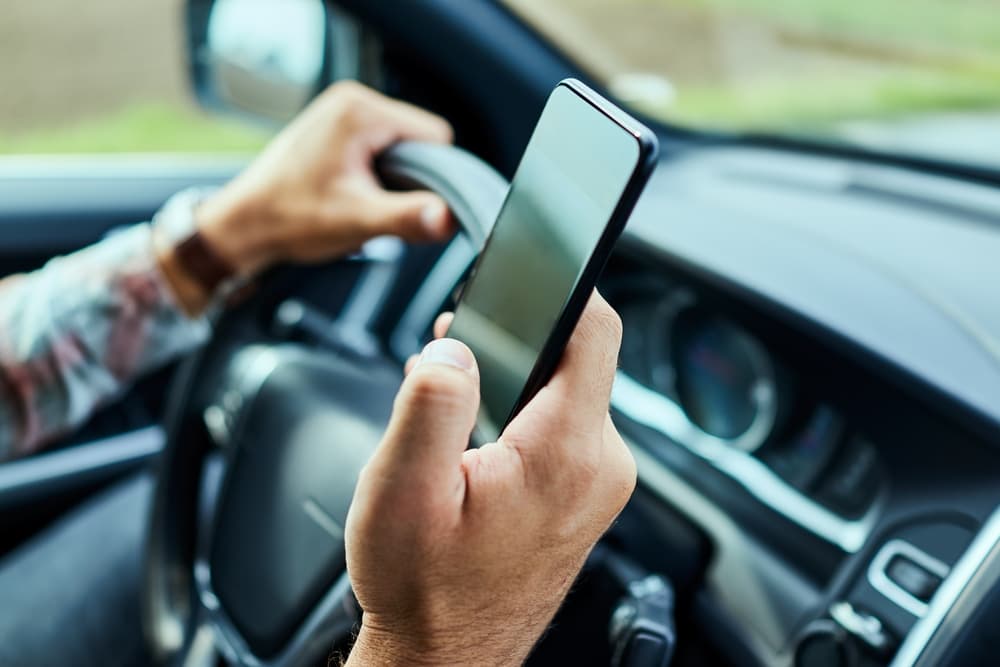
A manual distraction is any action that causes a driver to take one or both hands off the steering wheel for a reason unrelated to controlling the vehicle. Without two hands on the wheel, a driver’s ability to react to a sudden hazard, like a stopped car or a pedestrian, is severely compromised.
- Eating, drinking, or smoking
- Reaching for an item in the passenger seat or on the floor
- Adjusting the radio, climate controls, or other in-dash systems
- Holding a pet
- Applying makeup or grooming
Cognitive distractions: Taking your mind off driving
This is the most deceptive and widespread form of distraction. A cognitive distraction occurs when a driver’s mind is not focused on the task of driving, even if their eyes are on the road and their hands are on the wheel. You can be looking directly at a red light but not truly "see" it because your mind is elsewhere.
- Having a stressful or emotional conversation with a passenger
- Talking on a hands-free cell phone device
- Daydreaming or being lost in thought
- Experiencing road rage or intense anger
- Drowsiness or mental fatigue
Why Hands-Free Is Not Risk-Free
Many people believe that using a hands-free device, like Bluetooth or a speakerphone, eliminates the danger of using a phone while driving. This is a dangerous misconception. While these devices may remove the manual distraction, they do little to solve the most significant problem: cognitive distraction.
- "Inattention blindness": Research shows that drivers engaged in a phone conversation, even a hands-free one, can fail to see up to 50% of the information in their driving environment. They may be looking directly at a stop sign or a pedestrian but their brain does not process the information.
- Delayed reaction time: The mental load of a conversation slows a driver’s reaction time to the level of someone with a blood alcohol concentration of .08%. They are slower to brake and slower to make emergency steering maneuvers.
- A false sense of security: Because their hands are on the wheel, drivers using hands-free devices often believe they are being safe. This false confidence may lead them to engage in longer or more complex conversations than they otherwise would, further increasing the risk.
Distractions Inside Your Own Vehicle
Long before cell phones, drivers found plenty of ways to be distracted inside their own cars. These "traditional" distractions remain a significant cause of accidents today.
Eating, drinking, and personal grooming
Trying to manage food or a drink while driving is a recipe for disaster.
- A spilled hot coffee can cause a driver to jerk the wheel instinctively..
- Unwrapping a sandwich requires both hands and visual attention.
- Searching for a dropped water bottle can lead a driver to take their eyes off the road and swerve out of their lane.
Similarly, using the rearview mirror to apply makeup, shave, or fix your hair turns a safety device into a dangerous source of visual and manual distraction.
Interacting with passengers and pets
A car full of people or a roaming pet creates a highly unpredictable environment.
- Arguments or Deep Conversations: An emotional discussion with a passenger is a powerful cognitive distraction that can easily lead to road rage or inattention.
- Tending to Children: A parent’s instinct is to turn around to help a child in the back seat. This act takes their eyes, hands, and mind completely off the task of driving.
- Unrestrained Pets: A pet moving around the vehicle can get under the driver's feet, jump into their lap, or block their view, creating sudden and severe manual and visual interference.
Adjusting vehicle controls and technology
Modern vehicles are packed with technology, but much of it is not designed to be operated safely while the car is in motion. Complex infotainment touchscreens have replaced simple knobs and buttons, demanding more of a driver's visual attention.
- Searching through radio stations or playlists
- Adjusting complex climate control settings on a touchscreen
- Fine-tuning navigation system preferences while moving
Each of these actions requires a driver to look away from the road and divert their mental energy to the screen.
The Hidden Danger of Cognitive Driving Distractions
Distractions cause some of the most serious accidents without outward sign. A driver can appear to be doing everything right, eyes forward, hands on the wheel, but be mentally a million miles away.
- Fatigue and drowsiness: Driving while tired produces many of the same impairments as driving drunk, including delayed reactions and poor judgment.
- Daydreaming: Often called "highway hypnosis," this is when a driver zones out, especially on long, monotonous stretches of road. They are on autopilot, unable to react to sudden changes.
- Emotional state: A driver who is intensely angry, sad, or anxious cannot devote their full mental capacity to driving. Their emotional state clouds their judgment and shortens their fuse, making aggressive maneuvers more likely.
How Do You Prove the Other Driver Was Distracted?
If you suspect the driver in your accident was distracted, your word alone is insufficient. You need evidence to build a strong personal injury claim. A skilled attorney helps find and preserve this proof.
Gathering evidence after a distracted driving accident

The moments and days after a crash are critical for securing evidence. An investigation into the cause of the accident often uncovers telltale signs of distraction.
- The police report: When the police respond to an accident scene, the officer will take notes and often interview both drivers and any witnesses. The report may contain observations about a driver's behavior or statements they made admitting to a distraction.
- Witness testimony: Other drivers, pedestrians, or passengers who saw the crash are invaluable. They may have seen the other driver looking down at their phone or weaving in their lane just before the impact.
- Cell phone records: This is one of the most powerful pieces of evidence. Through a legal process called a subpoena, your attorney can obtain the other driver’s cell phone records. These records show the exact times of incoming and outgoing calls, texts, and data usage, which can be matched to the time of the crash.
- Social media and digital footprints: A timestamp on a social media post, email, or app usage can place the driver's attention squarely on their phone at the moment of impact.
- Vehicle "black box" data: Many modern cars have an event data recorder (EDR) that captures information about the vehicle’s speed, braking, and steering inputs in the seconds before a collision. This data can show a lack of any braking or evasive action, which is characteristic of a distracted driver.
- Video footage: Surveillance cameras from nearby businesses or traffic cameras may have captured the accident, providing indisputable proof of the driver's actions.
Proving what the other driver was doing is the key to demonstrating their negligence and securing the compensation you need to cover your medical bills, lost wages, and pain and suffering.
Frequently Asked Questions About Distracted Driving Accidents
Q: What if I was also distracted for a moment? Can I still file a claim in New York?
A: Yes. New York follows a "pure comparative negligence" rule. This means you can still recover damages even if you were partially at fault. However, the amount of compensation you receive will be reduced by your percentage of fault. For example, if you are found to be 10% at fault, your final award would be reduced by 10%.
Q: The driver who hit me denies they were on their phone. How can I fight that?
A: Denials are very common. This is why objective evidence is so vital. A driver can deny they were texting all they want, but they cannot argue with their own cell phone records that show data usage at the exact time of the police report. An attorney’s ability to subpoena these records is often the key to unlocking a case.
Q: Are there specific laws in New York about distracted driving?
A: Yes, New York has some of the strictest laws in the country against using portable electronic devices while driving. It is illegal to hold a phone to talk, compose or read texts or emails, or use any app while driving. A violation of this traffic law can be used as strong evidence of negligence in your personal injury claim.
Q: How can a lawyer help me if I was hit by a distracted driver?
A: A personal injury lawyer manages every aspect of your claim so you can focus on your recovery. This includes:
- Conducting a full investigation to gather all forms of evidence.
- Hiring accident reconstructionists if needed.
- Subpoenaing cell phone records and other critical data.
- Handling all communications with the insurance companies.
- Calculating the full value of your claim, including future medical needs.
- Fighting to secure a fair settlement or taking your case to trial if the insurer refuses to pay what you are owed.
From Distraction to Action: Reclaiming Your Life
The impact of a crash caused by a distracted driver stays with you long after you return home from the hospital. The physical pain, the mounting medical bills, and the stress of being unable to work can feel like too much to handle.

The driver who made that careless choice may have moved on with their life, but you are left with the consequences. You do not have to carry this burden alone. Taking legal action is your opportunity to hold that driver accountable and secure the financial resources you and your family need to move forward.
The legal team at Queller Fisher is committed to fighting for people injured by negligent drivers. For more than 60 years, we have provided determined representation to accident victims throughout New York City’s five boroughs—including Brooklyn, Queens, and the Bronx—as well as in Westchester, Nassau, Suffolk, and the surrounding counties.
We uncover the evidence needed to win. If a distracted driver has turned your world upside down, contact Queller Fisher for a free, no-obligation consultation about your case.
New York City Office: The Woolworth Building, 233 Broadway, 18th Floor, New York, NY 10279
Phone: (212) 406-1700
White Plains Office: 2 Westchester Park Drive, Suite 205, White Plains, NY 10604
Phone: (718) 892-0400